
Food Manufacturer Achieves ISO 8573-1 Compliance Through Enhanced Purity Audit
How a South Yorkshire Food Producer Verified System Integrity and Microbial Safety
A South Yorkshire food manufacturer based in Doncaster reached out to Search Air to validate their compressed air quality, and with good reason.
In food manufacturing, compressed air is everywhere. It powers pneumatic conveying systems that move ingredients, operates packaging machinery, drives automated production lines and is used directly in food processing and filling applications. What many manufacturers don’t fully appreciate is that this compressed air is in direct contact with their products, packaging, and food-handling equipment every single day.
That makes it a contamination risk. Compressed air generated by a standard compressor contains solid particulates drawn in from the atmosphere, moisture that condenses inside pipework and oil vapour from the compression process itself. Left unfiltered and untested, any of these contaminants can find their way into food products, introducing bacteria, mould, oil residues or foreign particles that compromise both product safety and quality.
Under HACCP principles, which every UK food manufacturer is legally required to follow, compressed air must be identified and managed as a Critical Control Point wherever it comes into contact with food. The BCAS Best Practice Guideline 102, produced in conjunction with the British Retail Consortium, sets out the minimum purity standards that food manufacturers must meet and verify through regular testing.
For this Doncaster manufacturer, that meant commissioning a full ISO 8573-1:2010 purity audit, including an additional microbial testing module to establish a baseline for airborne bacteria and mould across their production facility.
The Challenge
The client required rigorous verification that their compressed air met the stringent ISO 8573-1:2010 Class 1.2.1 standards for particles, water, and oil. While many facilities stop at standard purity tests, this manufacturer understood that warm, moist air lines can become breeding grounds for pathogens.
To ensure absolute consumer safety, they opted for an extra microbial testing module to establish a baseline for airborne bacteria and moulds.
The Solution
Our technical team, in partnership with BEKO Technologies, deployed a METPOINT® OCV mobile laboratory to the site. This high-precision rig allowed for real-time monitoring across three critical areas: the Main Compressor Room, the Kitchen Area (post-filtration), and Warehouse 4.
The audit utilised:
- PC400 Laser Particle Counters: Measuring solid particulates down to 0.1 microns.
- Easidew Dewpoint Sensors: Verifying pressure dew points (PDP) to ensure no moisture could condense in the lines.
- Metpoint OCV Sensors: Detecting residual oil vapour to ensure Class 1 (≤0.01 mg/m³) purity.
- Microbiological Sampling: Using specialised media to establish Total Colony Forming Units (CFU) for moulds and bacteria.
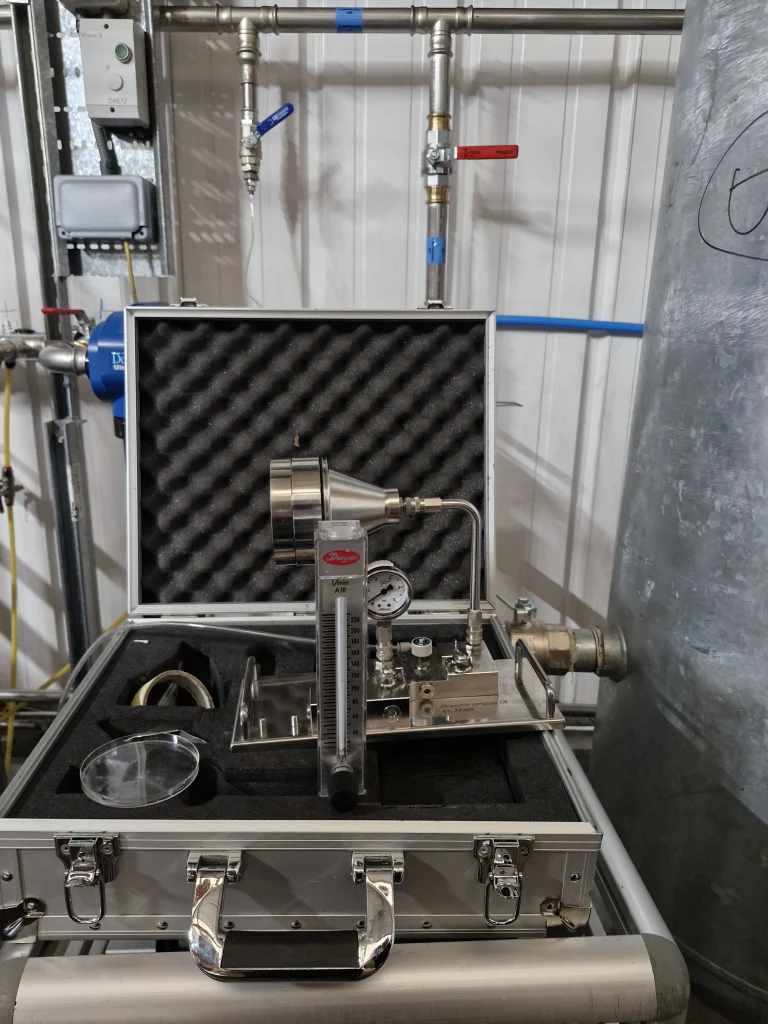
The portable BEKO Technologies audit kit deployed on site for the ISO 8573-1 purity audit at the Doncaster food manufacturing facility
The Results
The audit provided documented evidence across three critical test points within the facility: the Main Compressor Room, the Kitchen Area after filtration, and Warehouse 4.
Particulate Results: Class 1 Achieved
All three test points returned zero particles in the 1.0–5.0 micron range across the facility. The Kitchen Area and Main Compressor Room recorded particles in the smaller 0.1–0.5 micron range (105 and 812, respectively), but both remained well within the Class 1 threshold of 20,000 particles per m³. Warehouse 4 recorded zero particles across all size ranges. In practical terms, this means the filtration system is performing correctly and no solid contaminants are being delivered to food contact points through the air supply.
Dewpoint Results: Class 2 Achieved
Pressure dew points were recorded as -40.2°C in the Kitchen Area, -41.4°C in the Main Compressor Room and -46.7°C in Warehouse 4, all meeting or exceeding the Class 2 threshold of -40°C PDP. What this means in plain terms is that the air is dry enough that moisture cannot condense inside the pipework. Condensation inside air lines creates standing water which becomes a breeding ground for bacteria and mould; the dew point results confirm this risk is effectively eliminated across the facility.
Oil Vapour Results: Class 1 Achieved
Oil vapour content was measured at 0.0023 mg/m³ in the Kitchen Area, 0.0016 mg/m³ in the Main Compressor Room and just 0.0001 mg/m³ in Warehouse 4. All three results are significantly below the Class 1 threshold of 0.01 mg/m³. To put this into context, the Warehouse 4 reading is 100 times lower than the permitted maximum, meaning there is effectively no risk of oil contamination reaching food contact surfaces through the compressed air system.
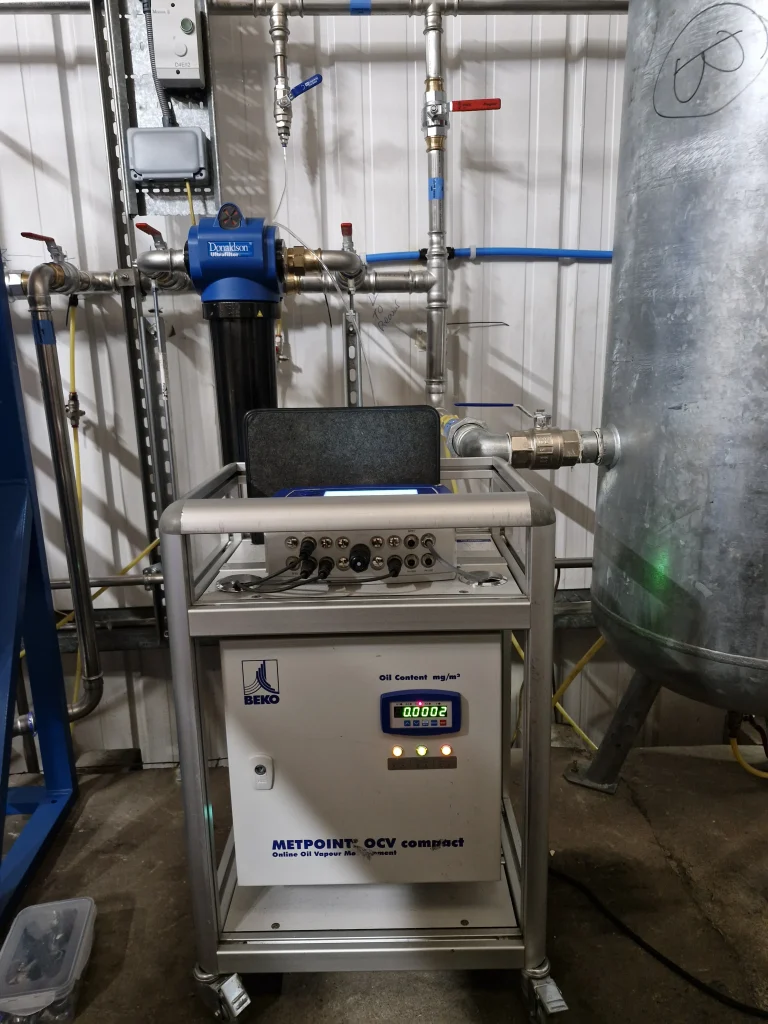
METPOINT OCV Compact monitoring unit installed at the Doncaster facility, measuring oil vapour content to ISO 8573-1 Class 1 standards
Microbial Results: Baseline Established
The additional microbial testing module, carried out by our specialist testing partner, returned the following Colony Forming Unit counts: Kitchen Area: 0 CFU, Main Compressor Room: 2 CFU (mould), Warehouse 4: 1 CFU (General Purpose Count). The kitchen area result of zero CFU is the best possible outcome for a direct food contact environment.
The trace mould identified in the compressor room at 2 CFU points to a minor intake filtration improvement opportunity, while the 1 CFU in Warehouse 4 is at a level that poses no food safety risk but provides a useful baseline for future comparison testing. All three microbial results are within acceptable parameters for a food manufacturing facility of this type.
What Are the Consequences of Non-Compliance?
For food manufacturers supplying major UK retailers, the consequences of failing a compressed air quality audit go well beyond a technical certificate. BRCGS auditors treat compressed air as part of the Pre-Requisite Programme and will look for documented evidence that testing has been carried out and that results meet the required ISO 8573-1 purity classes.
A failure to provide this evidence, or worse, a test result that falls outside the required class, can result in a failed BRCGS audit, putting retailer supply contracts directly at risk.
Beyond the audit room, the practical consequences of contaminated compressed air in a food production environment are significant. Oil contamination reaching a food contact surface can trigger a product recall. Moisture in air lines creates the conditions for bacterial and mould growth that can spread through an entire production batch before it is detected.
Particulate contamination from poorly maintained filtration can introduce foreign bodies into packaged products, one of the most common causes of consumer complaints and regulatory intervention in UK food manufacturing.
The BCAS Best Practice Guideline 102 exists precisely to help food manufacturers move from assumption to evidence. This Doncaster manufacturer chose to go beyond the standard purity test by commissioning the additional microbial module, establishing a documented baseline that not only satisfies their current BRCGS requirements but gives them a reference point for every future test. That is the difference between assuming your compressed air is safe and proving it.
Why Purity Validation Matters
By opting for a comprehensive audit including the microbial extra, this South Yorkshire food manufacturer moved from “assuming safety” to proving compliance. This data-driven approach allows the plant to satisfy third-party auditors and major UK retailers while protecting their brand reputation from the risk of contamination.
“Most food manufacturers assume their compressed air is clean because they can’t see anything wrong with it. This audit proved the system was performing well, but without the documented evidence, that assumption is worthless to a BRCGS auditor.”
Lee Ruddock, Business Development Manager, Search Air
Why Choose Search Air?
Search Air provides food grade compressed air testing and ISO 8573-1 purity audits across South Yorkshire and Doncaster. Contact our Sheffield depot on 0114 244 6521.”
As an employee-owned business and an Atlas Copco Premier Distributor, Search Air provides the technical depth required by highly regulated industries. We don’t just supply equipment; we provide the diagnostic expertise to ensure your “fourth utility” is safe, efficient, and fully compliant with PSSR 2000 and ISO standards.
Is Your Air Audit-Ready?
If you operate in the food, pharmaceutical, or electronics sectors, standard filtration may not be enough.
- Book your FREE airCHECK or Professional Purity Audit today.
- Email: air@wgsearch.co.uk
- Leeds: 0113 263 9081 | Nottingham: 0115 986 1141 | Sheffield: 0114 244 6521
- Web: compressive.co.uk