

Comparing Rotary and Piston Air Compressor Types
Comparing rotary and piston air compressor types starts with one point: the right machine depends on how your site actually runs. Duty cycle, pressure requirements, shift patterns, and air quality demands will determine the right answer faster than any headline specification.
Search Air, Atlas Copco Premier Distributor since 2002, supplies and services both compressor types across manufacturing, food processing, and engineering clients in Yorkshire and the East Midlands. We are ISO 9001:2015 / ISO 14001 / ISO 45001 certified. We don’t have a stake in which type you buy, only in making sure you don’t choose the wrong one.
This guide sets out the decision framework we use on site surveys.
How Each Type Compresses Air
Both compressor types are positive displacement designs: they trap a volume of air and reduce it to build pressure. The mechanics differ significantly, and those differences determine everything downstream.
A piston unit uses a crankshaft-driven cylinder. The piston retreats to draw air in through an inlet valve, then advances to compress and discharge it. This produces a pulsed airflow, with pressure spikes between each compression stroke that become more pronounced at higher delivery pressures.
The reciprocating action also generates heat that accumulates in the cylinder head and valve assembly with every stroke, which is why thermal management is central to understanding piston compressor limitations.
How a Rotary Screw Works
A rotary screw machine meshes two helical rotors in counter-rotation. Air enters at one end, is trapped between the rotor profiles as they mesh, and is compressed continuously as it travels toward the discharge port. There are no valves, no piston strokes, and no pressure pulses.
Output is smooth and continuous. This mechanical simplicity is one reason rotary screw units accumulate significantly more service hours before requiring major overhaul. There are fewer wearing surfaces, no valve plates to crack, and no connecting rod bearings subjected to the shock loading that characterises a reciprocating design.
For production environments where uptime is a primary concern, that design difference has direct operational consequences.
Efficiency Comparison
- Rotary screw: smooth, continuous airflow, 4–5 CFM per horsepower input
- Piston: pulsed airflow, 3–4 CFM per horsepower input
- Crossover point: the screw type outperforms the piston at approximately 15 kW (20 hp) and above, per Atlas Copco’s compressor selection guidance (atlascopco.com)
That efficiency gap compounds at scale. For a site running a 37 kW unit at 8 hours per day, the difference between 3.5 and 4.5 CFM per horsepower is a measurable electricity cost, not a footnote on a spec sheet.
Across a ten-year asset life, the cumulative energy saving on a unit of that size at current UK electricity rates is substantial, enough to shift the conversation from capital cost comparison to lifecycle investment, which is the correct framing for any compressor decision in continuous industrial service.
Duty Cycle: the Specification Most Buyers Misread
A piston unit rated at 60% duty cycle will overheat and fail if run continuously. This isn’t a conservative design margin; it’s the threshold between a long-serving asset and an unplanned production stoppage.
Duty cycle is the percentage of time a compressor can run at full load within a given period, typically an hour. A 60% rating means 36 minutes on, 24 minutes off, repeating. The off-time is when the cylinder head, valve plates, and connecting rod bearings cool down.
Common duty cycle ratings by compressor type:
What Happens When the Limit Is Exceeded
Piston units operate at discharge temperatures between 300°F and 400°F (149–204°C). Oil-injected rotary machines run at 170–200°F (77–93°C) because oil cooling is integral to the compression cycle.
That temperature gap explains why the duty cycle is structural for pistons but irrelevant for continuous-duty screw designs.
The Failure Sequence
When a piston runs beyond its rated duty cycle, the failure sequence is predictable:
- Head temperatures exceed design limits, accelerating valve plate wear
- Lubricating oil degrades faster than the service interval assumes, losing viscosity
- Bearing surfaces run hot and wear at an accelerated rate
- Unplanned downtime follows, often with a long lead time on replacement components
The problem is compounded by the fact that duty cycle breaches rarely announce themselves. A production line expands, a second shift is added, and an additional pneumatic tool is introduced to the circuit. Each change increases compressor runtime without anyone formally reviewing whether the machine’s duty cycle rating still matches the new demand profile.
How Breaches Go Undetected
By the time the bearing starts to knock, the unit has been running outside its design envelope for months. There is rarely a single event that triggers the failure. It is cumulative degradation across hundreds of operating hours above the rated limit.
A Real-World Scenario
Consider a fabrication shop in Doncaster running two shifts on a 7.5 kW piston unit rated at 60% duty cycle. Under single-shift intermittent use, it runs without issue. Move to a two-shift operation supplying air tools for six or seven continuous hours, and the unit is running outside its design envelope every day.
The failure isn’t dramatic. Pressure drops, a bearing starts to knock, a valve plate cracks, until the line stops. A continuous-duty machine of equivalent output, specified for the same two-shift application, would run indefinitely at that demand level.
The capital cost difference is recovered within the first two or three years when maintenance costs, unplanned downtime, and replacement parts are included in the comparison.
When a Piston Compressor Is the Right Choice
Most comparison articles present the piston as the budget fallback. That framing is wrong. There are specific scenarios where it is the technically correct answer, not just the cheaper one.
High-Pressure Applications
Standard single-stage screw machines typically deliver up to 13 bar. Multi-stage piston designs reach 20, 30, or even 40 bar, covering PET bottle blowing, nitrogen boosting, and test and calibration rigs. For those pressure requirements, a piston isn’t a compromise; it’s the only practical option.
Specialist high-pressure screw designs exist but are far less common and considerably more expensive than multi-stage reciprocating units at equivalent delivery pressures. If your process genuinely requires 25 bar or above, the specification decision is straightforward.
- Very high pressure (above 13 bar): multi-stage piston is standard
- Intermittent use, short cycles: the duty cycle limitation becomes irrelevant
- Small workshop, modest flow: where runtime is under 4 hours per day, piston’s lower capital cost is difficult to justify against
- Tight capital budget, low hours: the TCO advantage of continuous-duty machines doesn’t materialise until runtime hours accumulate
Low-Hours Operations
Where a site genuinely runs a compressor for short bursts, a joinery workshop uses a nail gun intermittently, or a small bodyshop sprays for a few hours per week, a piston unit is a sensible buy. The 10,000–15,000-hour lifespan of a typical piston unit isn’t a problem if the machine accumulates 500 hours per year. At that pace, the asset runs for 20 years.
The key qualifier is that the usage pattern must be stable. If there is any realistic prospect of the business expanding production, adding a shift, or increasing the number of pneumatic tools on the circuit, it is worth modelling the alternative at the outset. Retrofitting a larger or different compressor type later, including new air receivers, pipework, and electrical supply, is significantly more expensive than specifying correctly from the start.
Total Cost of Ownership: Where the Gap Becomes Significant
Capital cost is one line. Energy accounts for 80% of the total lifecycle cost of a compressor in industrial service. The TCO calculation shifts significantly depending on annual runtime hours.
Take a manufacturing site in West Yorkshire running a compressor for 8 hours per day, 220 days per year (1,760 hours annually). UK non-domestic electricity currently averages approximately £0.28–0.34/kWh. The table below shows the practical comparison between an 11 kW piston and an equivalent continuous-duty unit.
Long-Run Savings
At 1,760 hours annually, service intervals diverge quickly. Screw compressor maintenance typically falls every 4,000 hours versus every 500–1,000 hours for piston, which means more maintenance events on the piston machine over the same operating period. Service cost differential over 10 years often exceeds the original capital cost gap, and that’s before accounting for the piston’s shorter lifespan of 10,000–15,000 hours versus 40,000–60,000 hours for a well-maintained screw unit.
Downtime and Indirect Costs
It is also worth factoring in the indirect costs that rarely appear in a purchase comparison. An unplanned stoppage on a production line has a cost per hour that typically dwarfs the service cost of the compressor itself. Sites that have experienced a compressor failure during a busy production period consistently report that the downtime cost was the larger number.
Reliability is a financial specification, not just an operational preference. Use our Air Compressor Calculators to model your own runtime hours and energy costs before committing to either type.
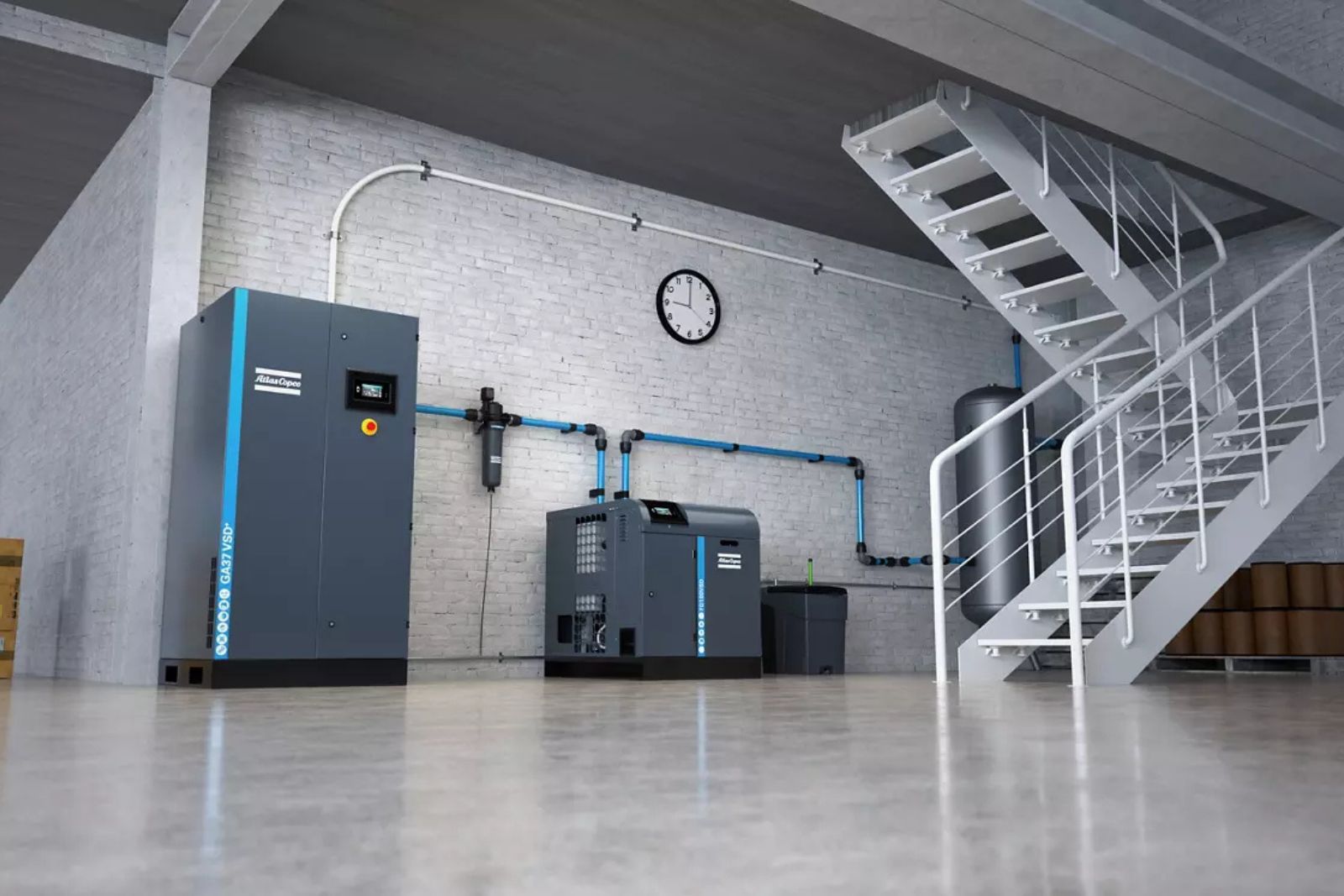
Atlas Copco compressed air installation in a manufacturing setting, where lifecycle cost, layout, and duty cycle all affect the right compressor choice.
Noise Levels and Where You Can Locate Each Type
Screw machines typically operate at 60–70 dB(A). Piston units are louder, typically 70–90 dB(A) depending on size and configuration, with vibration characteristics that vary by stroke rate.
What That Means for Siting
The UK HSE Noise at Work Regulations (hse.gov.uk) set an upper action value of 85 dB(A) and a lower action value of 80 dB(A). A piston unit running at 85 dB(A) puts workers nearby into the lower action value band, while a screw machine at 65 dB(A) in the same location does not. The Health and Safety Executive guidance makes clear that employers must take action once workers are regularly exposed to levels above the lower threshold.
Splitting that paragraph into the following practical implications makes the compliance picture easier to apply on site.
Practical Siting Implications
- Piston at 80–90 dB(A): requires a dedicated compressor room or significant setback. Vibration isolators are recommended to prevent structure-borne noise transfer.
- Screw type at 60–70 dB(A): can often be located in or adjacent to the production area without triggering hearing protection requirements. Some GA series units are specified for open-floor installation
- Both types benefit from proper pipework design to prevent pressure drop penalties from poor layout.
If your building cannot accommodate a separate compressor room, the quieter noise profile of a continuous-duty machine can become a practical requirement, not a preference.
Future Flexibility
Noise compliance also affects future flexibility. A site that installs a piston unit in an open production area may find that subsequent workforce expansion or a shift-pattern change creates a compliance obligation to either relocate the machine or provide hearing protection across a wider area. A machine specified at the outset with a lower noise signature avoids that exposure.
Air Quality: Oil-Injected vs Oil-Free Configurations
Most piston units used in industrial service are oil-lubricated. Most screw machines used in manufacturing are oil-injected. These are not the same configuration, and the distinction matters for regulated industries.
- Oil-injected: oil circulates through the compression element, providing cooling and sealing. Downstream filtration is required to achieve clean air classifications
- Oil-free: compression elements operate without lubricant contact, delivering inherently cleaner air. ZR and ZT series machines deliver ISO Class 0 air without downstream oil removal stages
- Oil-free with filtration: oil-injected units can achieve acceptable purity with properly specified downstream filters, but oil carry-over risk remains higher than with a true oil-free design
ISO 8573-1 and Sensitive Applications
ISO 8573-1 defines compressed air purity classes from Class 0 (highest purity) through to Class 6. Food processing, pharmaceutical manufacturing, and medical applications typically require Class 1 or Class 2 air quality, with oil content measured in aerosol, vapour, and total concentration.
Suppliers operating under ISO 9001:2015 quality management systems are expected to document and control compressed air specifications that affect product quality. Sites with ISO 14001 environmental certification may face additional scrutiny over oil carry-over and condensate disposal. ISO 45001 occupational health requirements can also apply where compressed air contacts personnel or food-grade surfaces.
Contamination Risk and Specification Response
For a food processing site supplying air to direct-contact packaging lines, a single contamination event from oil carry-over can trigger a product recall. Eliminating the contamination pathway entirely is the correct specification response. Downstream filtration systems require their own maintenance regime: a coalescing filter that is not changed at the correct interval will pass oil carry-over regardless of its rated performance.
Explore how filtration interacts with compressor type in our guide to Types of Air Compressor Filters and How They Work.
Making the Selection Decision
Before specifying either type, the data you need includes average flow demand (l/s or CFM), peak demand, operating pressure, daily runtime hours, shift pattern, and whether air quality standards apply. Without those figures, any comparison between a piston and a rotary screw compressor remains theoretical.
Demand Profiling and Sizing
A site audit gathers that data directly, mapping actual demand against available options at the relevant duty point. Many sites assume their peak demand is the relevant figure, but a system sized to peak demand and running at partial load for most of its operating hours will perform less efficiently than one matched to actual average demand with appropriate storage. Oversizing wastes capital.
Undersizing causes pressure drop events that affect tool performance, weld quality, and spray finish consistency.
Variable Speed Drive: a Third Consideration
Sites with variable demand across a shift should also consider whether a variable speed drive (VSD) rotary screw unit is more appropriate than a fixed-speed machine. A fixed-speed screw compressor loads and unloads to match demand, resulting in energy waste during the unload phase. A VSD unit modulates motor speed to match actual flow demand in real time, typically saving 20–35% in energy consumption compared with a comparable fixed-speed model when demand varies significantly throughout the working day.
Atlas Copco’s GA VSD+ range is a common specification at sites with mixed tool usage, where demand can vary between 40% and 100% of rated flow depending on which processes are running. The additional capital cost of a VSD unit is usually recovered within two to four years at industrial operating hours. For sites currently running a fixed-speed piston or screw unit and experiencing frequent load/unload cycling, retrofitting to a VSD machine is one of the most cost-effective energy improvements available without changing the compressed air network itself.
Compressed Air Audits and Leak Detection
Before sizing any new compressor, it is worth establishing how much of the current demand is genuine process air and how much is leakage. Industry estimates consistently place compressed air system leakage between 20% and 30% of total output on sites that have not had a formal leak detection survey.
At those rates, a site sizing a replacement compressor against current consumption may be specifying a machine large enough to sustain a significant leak rather than one matched to actual production requirements.
A leak detection survey using ultrasonic detection equipment can identify and quantify leaks across an entire distribution network. Fixing identified leaks before commissioning a new compressor frequently reduces the required output by enough to move down a capacity band, which changes both the capital cost and the ongoing energy cost of the installation. Search Air carries out compressed air audits as part of site surveys across Yorkshire and the East Midlands.
Decision Summary
Frequently Asked Questions
What Is Duty Cycle and Why Does It Matter When Choosing a Compressor?
Duty cycle is the percentage of time a compressor can run loaded in any given period without overheating. A piston unit rated at 60% duty cycle must rest for 40% of each hour. A continuous-duty screw machine runs at 100% duty cycle because oil injection cooling is integral to the compression process, not separate from it.
At What Point Does a Screw Compressor Become More Cost-Effective Than a Piston?
The screw type outperforms the piston on efficiency at approximately 15 kW (20 hp) and above. For sites running 1,500 or more hours annually, the 4–5 CFM per horsepower performance band versus 3–4 CFM is usually enough to offset the higher purchase cost over the machine life. When service interval savings and longer asset lifespan are added to the energy cost differential, the payback period on the higher upfront investment is typically three to five years at industrial operating hours.
Do I Need Oil-Free Compressed Air for Food or Pharmaceutical Production?
ISO 8573-1 defines purity classes for compressed air. Food contact and pharmaceutical manufacturing typically require Class 1 or Class 2 air. An oil-free machine eliminates the contamination pathway.
Oil-injected units can achieve acceptable purity with downstream filtration, but the risk profile is higher for direct-contact applications. The additional maintenance discipline required to keep downstream filtration performing to specification, combined with the audit and documentation burden under food safety and pharmaceutical quality frameworks, means that managing an oil-injected system to Class 1 or Class 2 compliance often costs as much as specifying oil-free at the outset.
How Do I Know What Size Compressor My Site Needs?
Compressor sizing should be based on measured demand rather than estimated demand. The most common sizing errors are using nameplate ratings on individual tools rather than actual consumption figures, and failing to account for simultaneous usage patterns across the site. A site audit that logs actual system pressure over a full shift, combined with a flow measurement at the compressor outlet, provides the data needed to specify correctly.
Oversizing wastes capital and reduces part-load efficiency. Undersizing causes pressure drop events that affect process quality and can lead to the compressor running beyond its rated duty cycle.
What Is a Variable Speed Drive and When Does It Make Sense?
A variable speed drive (VSD) compressor adjusts motor speed in real time to match actual compressed air demand, rather than switching between full load and unload like a fixed-speed machine. The energy saving on sites with variable demand is typically 20–35% compared with a fixed-speed equivalent.
VSD becomes the correct specification when demand fluctuates meaningfully across a shift, for example, on sites where the number of tools running at any one time changes significantly between morning production and afternoon finishing work.
Fixed-speed machines are more cost-effective where demand is consistent, and the compressor runs at or near full load for most of its operating hours.
If you’re weighing up compressor types for your site, the right answer depends on data we can only get by looking at how your system actually runs.
Contact Search Air to arrange a free air check. We cover Leeds, Sheffield, Nottingham, and the manufacturing sites between them.