
Services
Food Grade Compressed Air Testing
“Class 0 oil-free air” has no legal meaning unless specific purity limits are agreed in writing with your supplier. Many food manufacturers believe they are compliant when, in reality, they have nothing to show an auditor.
Search Air’s food grade compressed air testing service gives you exactly that: UKAS-traceable certificates, produced at your points of use, that satisfy ISO 8573-1:2010 and stand up to BRCGS Issue 9 scrutiny.
As an Atlas Copco Premier Distributor with over 80 years of experience serving food manufacturers across Leeds, Sheffield, Nottingham, Yorkshire, and the East Midlands, we do more than hand you a result.
We identify the root cause of any failure, recommend the right fix, and provide the documented evidence your next audit demands.

Why Does Compressed Air Need Testing in Food Production?
Compressed air is not simply air – it’s ambient air concentrated under pressure. This magnifies every contaminant present at the inlet. Solid particulates, water vapour, oil aerosols, and microbes are all drawn in and intensified. But without a documented food safety compliance framework, these contaminants reach your product undetected.
The Hidden Dangers in ‘Just Air’
Three contamination categories threaten food safety in every compressed air system.
- Solid particulates – pipe scale, rust, and atmospheric dust that carry bacteria into the product stream
- Water – untreated ambient air contains 5 to 25 grams of water per cubic metre, creating conditions for microbial growth inside pipework
- Oil – ambient air naturally carries 1 to 5 micrograms of oil per cubic metre, which concentrates further under compression and acts as a nutrient source for bacteria
Biofilm – a structured colony of bacteria adhered to wet pipe walls – is the most persistent risk.
Once established, it acts as a continuous contamination source that is extremely difficult to remove. Gram-negative bacteria such as Pseudomonads cause taints, discolouration, and slime at product concentrations of 10⁷ to 10⁸ CFU/g, per International Commission on Microbiological Specifications for Foods (ICMSF) literature.
Direct vs. Indirect Contact: A Critical Distinction
BCAS Best Practice Guideline 102 defines two contact categories, each requiring different minimum purity classes.
Direct contact air physically touches food, ingredients, or the interior of primary packaging. Indirect contact air is exhausted into the production environment without touching the product directly.
A common assumption is that indirect contact with air is low risk. It’s not. Air exhausted into a production environment settles on surfaces, equipment, and open packaging – becoming a secondary contamination source that many HACCP plans miss entirely.
A facility can achieve perfect direct contact air quality and still fail a BRCGS audit because of environmental contamination traced back to an indirect compressed air source. Environmental contamination traced to indirect air has triggered product recalls and retailer delisting in documented GFSI investigations.
Our on-site point-of-use testing service – not outlet-only sampling – provides the UKAS-traceable documented evidence you need to prove both contact categories are safe and compliant at every BRCGS audit point.

Decoding ISO 8573-1: The Global Standard for Air Purity
ISO 8573-1:2010 is the primary international standard specifying maximum allowable contamination limits for compressed air, setting the quality standards all food-contact applications must be measured against. Every purity class is expressed as three numbers in the format [P:W:O], representing particles, water, and oil, respectively. Understanding this notation is the starting point for specifying food grade compressed air correctly.
The Three Pillars: Particles, Water, and Oil
| Contaminant | Class 1 Limit | Class 2 Limit |
| Particles (1.0–5.0 µm) | ≤10 per m³ | ≤100 per m³ |
| Water (Pressure Dew Point) | ≤ −70°C | ≤ −40°C |
| Total Oil (liquid + aerosol + vapour) | ≤ 0.01 mg/m³ | ≤ 0.1 mg/m³ |
One rule applies across Classes 1 to 5: the presence of any particle greater than 5.0 microns immediately invalidates the classification, regardless of all other results. This makes point-of-use filtration non-negotiable.
What Purity Class Does Your Application Really Need?
BCAS Best Practice Guideline 102 recommends a minimum of ISO 8573-1:2010 [2:2:1] for direct food contact and [2:4:2] for indirect contact. The water class is the most operationally significant figure. A Class 2 Pressure Dew Point of −40°C actively inhibits all microbial growth inside pipework. Class 3 at −20°C doesn’t.
“Class 0” is not a default superior setting. It’s a user-defined classification requiring contamination limits stricter than Class 1, agreed in writing before. Without that written agreement, the term carries no contractual weight and provides no audit protection.
Achieving these standards depends on the complete system – compressor, dryers, and filters – not the compressor alone. We help you understand your specific requirements and design a system that meets them reliably.
See how we helped a South Yorkshire food manufacturer achieve ISO 8573-1 Class 1.2.1 compliance.
How Do We Conduct Audit-Ready Food Grade Compressed Air Testing?
Our professional air quality testing is conducted at your points of use, not at the compressor outlet. This distinction matters because pipework contamination between the compressor and the point of use is a primary failure source that outlet-only testing will never detect.
The On-Site Sampling Process: Precision and Aseptic Technique
We use three instruments simultaneously at each test point.

A laser particle counter measures solid contaminants by micron size band

A calibrated dew point sensor records the Pressure Dew Point (PDP) in °C

A sieve impact air sampler captures a microbial sample on an agar plate for laboratory analysis under ISO 8573-7:2003
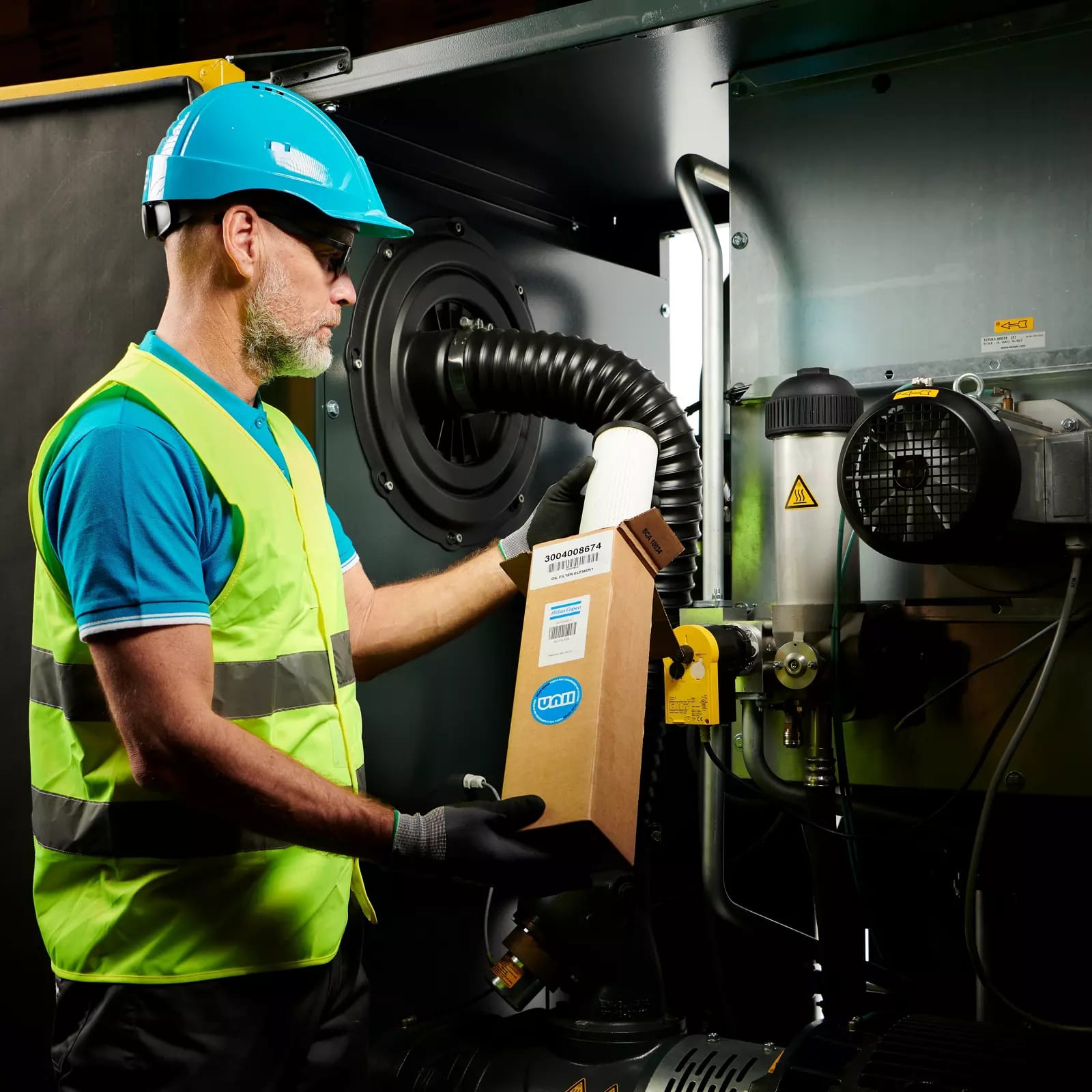
Aseptic technique during microbial sampling is where many third-party tests fail. Our engineers use sterility blanks and operational blind plates throughout every test batch. Under ISO 8573-7, the sterility blank plate must yield <1 CFU/plate to validate the entire batch.
A single lapse in aseptic procedure results in a false positive, and businesses then spend thousands on unnecessary filter changes to chase a contamination source that existed only in an invalid test.
What Your UKAS-Traceable Certificate Contains
Your final certificate, traceable to UKAS ISO/IEC 17025 standards, documents:
- Solid particle count by micron size band
- Pressure Dew Point in °C
- Total oil concentration in mg/m³
- Microbial count in CFU/m³
- A statement of compliance against your specified ISO 8573-1 class
This certificate satisfies BRCGS Issue 9, Clause 4.5.3, which mandates that compressed air in direct product contact must be filtered at the point of use and monitored. It’s the tangible proof GFSI-recognised auditors and major retailers need.
What Happens if Your Compressed Air Fails the Test?
A failed test is a contamination risk that must be resolved before the next production run. The cause could be a failing dryer, degraded pipework, incorrect lubricant, or legacy oil residue in pipework previously connected to a lubricated machine.
Root Cause Analysis: From Compressor to Point-of-Use
One critical point many businesses miss: fitting a new oil-free compressor to legacy pipework doesn’t produce oil-free air at the point of use. If that pipework previously carried air from a lubricated machine, residual oil coats the pipe walls. The clean air from the new compressor leaches that legacy oil and carries it forward – a five-figure capital investment can still produce a failed oil contamination test if the pipework is not replaced or thoroughly purged.
A five-figure compressor investment is effectively written off until the pipework is replaced, with production halted in the interim.

Engineered Solutions for Guaranteed Compliance
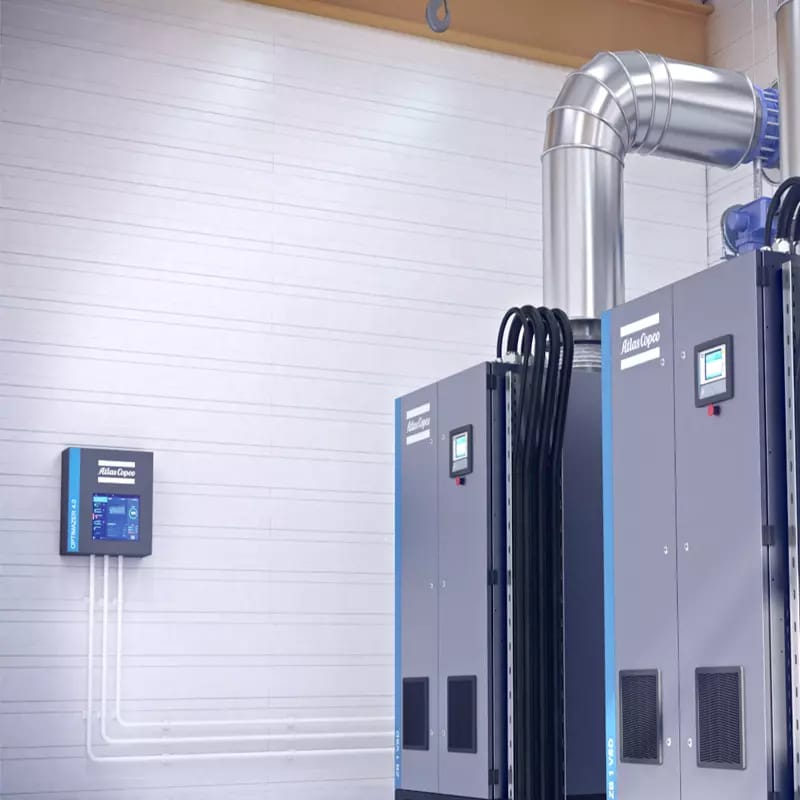
Oil contamination is resolved at the source with Atlas Copco ZR/ZT Oil-Free Compressors (Z Series), delivering certified Class 0 air with no oil in the compression chamber. Where an immediate upgrade is not feasible, Roto Synthetic Foodgrade lubricant is the certified interim option for lubricated machines.
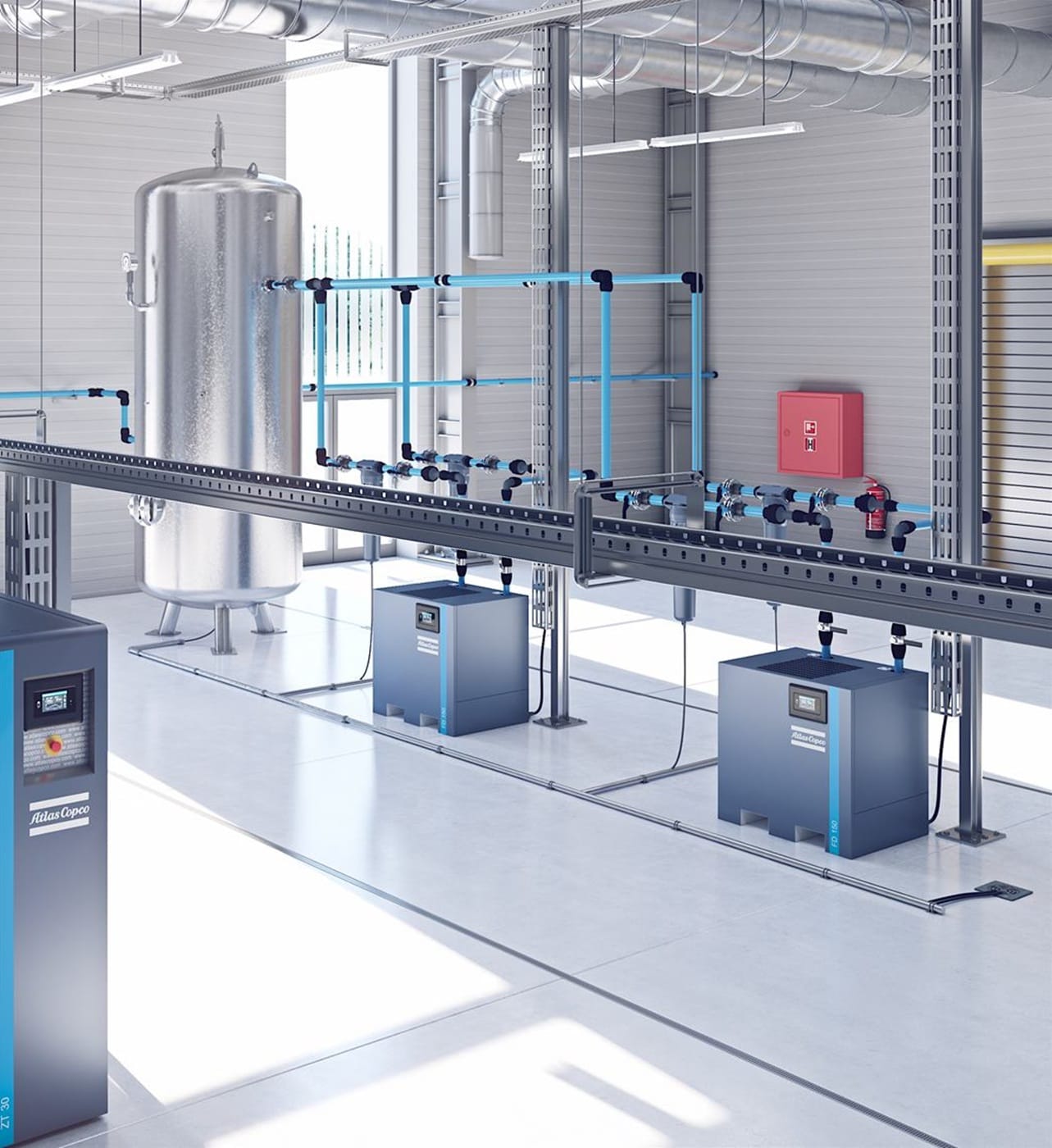
Water and microbial contamination needs a Desiccant Air Dryer from the MDG/MD/ND Series, reliably achieving a −40°C to −45°C PDP – the threshold that stops microbial growth. Cerades™ solid desiccant dryers eliminate the abrasive dust and pressure drops associated with traditional loose-bead desiccants, removing an additional contamination risk.
Particle and microbial contamination at the point of use is addressed with Sterile Filters, capturing 99.999% of viable microbes before direct food contact.
SMARTLINK remote monitoring provides continuous air monitoring between scheduled tests, uploading 30 operational datapoints every 5 minutes and delivering early warning of dryer or filter degradation. Variable Speed Drive (VSD) technology reduces energy consumption by an average of 50% compared to fixed-speed models, cutting running costs while maintaining continuous compliance.
Choosing Search Air: Your Partner in Compressed Air Compliance
Search Air has served food manufacturers across Leeds, Sheffield, Nottingham, Yorkshire, and the East Midlands since 1946. Our status as an Atlas Copco Premier Distributor since 2002 – and recognition as Atlas Copco Distributor of the Year 2022 – reflects the technical depth we bring to every site visit.
80 Years of Experience, Now Owned by the People Who Serve You
We operate as an Employee Ownership Trust (EOT), meaning every engineer on your site holds a personal stake in the business and is personally invested in getting your compliance right. We hold ISO 9001 and SafeContractor/CHAS accreditations.


Legally ‘Competent Persons’ for PSSR 2000 Compliance
Under the Pressure Systems Safety Regulations 2000 (PSSR) (S.I. 128), regulations apply to any system operating above 0.5 bar. A formal Written Scheme of Examination (WSE) is legally mandatory for any system exceeding 250 bar-litres (pressure in bar multiplied by vessel volume in litres).
Our engineers are legally designated Competent Persons under PSSR 2000, qualified to review your WSE, conduct statutory examinations, and certify safe operational limits – covering the entire pressure system, not just the receiver vessel.
Our free #airCHECK assessment is the right first step for any food manufacturer who wants an honest, no-obligation overview of their system’s compliance position.
Walk your production line now. Identify every point where compressed air contacts your product or primary packaging – that is your critical risk map. Then book your free #airCHECK with Search Air, serving Leeds, Sheffield, Nottingham, Yorkshire, and the East Midlands.
Frequently Asked Questions
Compliance with ISO 8573-1:2010 is the primary requirement. For direct food contact, BCAS Best Practice Guideline 102 recommends a minimum class of [2:2:1] – a −40°C pressure dew point, minimal particles, and total oil below 0.1 mg/m³.
We test at your points of use using a laser particle counter, a dew point sensor, and a sieve impact air sampler under ISO 8573-7. Results are compiled into a UKAS ISO/IEC 17025-traceable certificate covering particles, water, oil, and microbial count.
BCAS Best Practice Guideline 102 recommends regular testing at a minimum of twice per year. Re-test immediately after any significant system maintenance – filter changes, pipework modifications, or dryer servicing – to confirm air purity has not been compromised.
DIY testing kits lack the accuracy, traceability, and aseptic rigour required for a BRCGS or GFSI audit. Auditors expect impartial, third-party results from calibrated equipment using validated ISO 8573-7 microbial sampling technique. Results won’t satisfy BRCGS Issue 9, Clause 4.5.3.