
What Is Compressor Connectivity?
Air compressors are vital to the day-to-day running of businesses in countless industries, serving as the “fourth utility” alongside electricity, water, and gas. Unfortunately, like any other crucial industrial equipment, compressed air systems are prone to problems and breakdowns over time and through general wear and tear. Any downtime can seriously harm your business due to how essential your compressor is to your operation.
A faulty or problematic compressor does not just risk business downtime – it can also lead to unnecessarily high energy bills and greenhouse emissions. Moreover, the repairs can sometimes cost an arm and a leg.
Fortunately, by investing in advanced compressor connectivity solutions, you can minimise the risk of compressor issues resulting in downtime and adversely impacting your bottom line. Essentially, compressor connectivity refers to connecting your compressor to a central hub via technologies such as the Internet of Things (IoT) and cellular connectivity. This allows you to access real-time monitoring data on your system’s performance remotely and catch small issues before they spiral out of control.
At Search Air, we are committed to remaining at the cutting edge of industrial compressor technology. That is why we proudly offer remote connectivity services to bring your operations into the 21st century and support the shift toward smart factories. Many Atlas Copco compressors can be retrofitted with innovative connectivity solutions, allowing you to use the latest smart tech without investing in a new compressor system.
Naturally, upgrading your compressor can bring a plethora of benefits. In this guide, you will learn about compressor connectivity, how technologies like SmartLink work, and the features the latest compressors have. That way, you can decide whether investing in a new system or simply retrofitting your existing system is the wisest investment for you.
Evolution of Compressor Systems
In the not-so-distant past, the only way to monitor the performance of your compressor was manually. Often, this meant that issues could only be identified during scheduled maintenance visits, which means seemingly minor problems such as excessive vibration and fluctuating pressures could go unnoticed until they become costly to repair.
Now, thanks to remote monitoring systems, you can track various aspects of your compressor’s performance remotely and in real time—helping you catch inefficiencies before they become costly problems.
To implement compressor connectivity on an existing system, our professionals attach sensors to various elements of your compressor to collect data on parameters such as temperature, pressure, dew point, energy consumption, and vibration levels. These sensors access your cellular or Wi-Fi network and transmit the data to a central hub. You can then access this data using an intuitive smartphone app, which makes small issues much faster to detect.
This transition from reactive to predictive maintenance revolutionises how plant managers oversee their equipment. Instead of waiting for a breakdown, connectivity allows you to make informed decisions based on live data.
You do not need to rely on data analysis to remain informed. Our connectivity solutions are configured to send you automatic alerts and notifications when something requires your attention.
While existing Atlas Copco compressors can be retrofitted with sensors, there are many advantages to investing in a more modern system. In addition to collecting air pressure and temperature data, modern systems have various sensors that detect operating errors, faulty parts, and unexpected deviations from standard operation. They can even automatically optimise your system to run continuously at maximum efficiency, requiring barely any intervention from you in the meantime.
Compressor connectivity uses real-time monitoring and control to reduce downtime, improve efficiency, and prevent costly failures.
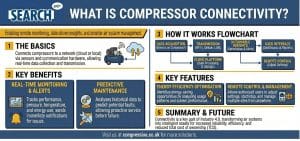
Compressor connectivity uses real time data to reduce downtime improve efficiency and prevent costly failures
Benefits of Implementing Compressor Connectivity
Whether your workplace relies on a single compressor or multiple units working together in a complex compressor room, implementing connectivity solutions brings tangible benefits. Being able to see how your entire compressed air system is functioning without manual intervention offers advantages that include:
Automated Notifications for Critical Issues
Connected compressors monitor their performance and health continuously. If a critical issue arises, such as a pressure drop, abnormal temperature fluctuation, or excessive vibration, you will receive a mobile alert automatically and near-instantly, regardless of your location. These notifications enable you to act swiftly when problems arise and can prevent production stoppages and costly breakdowns.
Minimised Equipment Downtime
Thanks to the reliable and timely alerts of connected compressors, you can continuously optimise your system. You will be notified of issues that are not pressing but could benefit from being addressed, such as overheating due to poor ventilation. With fewer breakdowns between scheduled maintenance sessions, you can make preventative maintenance more consistent, ensuring high reliability.
Remote Optimisations and Setups
Thanks to compressor connectivity, you are no longer required to manually configure your system every time changes are made. Instead, you can use remote monitoring and control to optimise settings such as flow rates and pressure levels using a simple web or mobile app. This allows you to finetune your system much more easily. Just think of how many working hours you could save with this ability. Plus, remotely adjusting your system makes your workplace more efficient, productive and safe.
Improved Energy Efficiency
The most expensive aspect of running a compressor concerns energy usage, often referred to as the “fourth utility” cost. In some industrial settings, compressed air systems can account for up to 40% of the facility’s overall energy consumption. By catching small problems early and optimising pressure levels, you can ensure that your system continuously runs at maximum efficiency, which could shave a significant sum off your annual energy bills and reduce energy consumption by up to 35%. It can also help you comply with ever-changing regulations, such as ESOS and ISO 50001, and minimise your carbon footprint.

What Is Compressor Connectivity?
Spotlight on Atlas Copco’s SmartLink
For those utilizing equipment from manufacturers like Atlas Copco, the SmartLink system represents the gold standard in connectivity technology. SmartLink is a remote monitoring platform that gathers data from your compressed air equipment and sends it to the cloud. It offers three tiers of service:
- Service: Provides a logbook of running hours and service status to streamline maintenance planning.
- Uptime: Sends alerts for critical issues to prevent unplanned downtime.
- Energy: Offers detailed insights into energy costs and consumption to help you comply with ISO 50001.
Many GA VSD⁺ and ZT Oil-Free units come with built-in SmartLink support, but older models can also join the connected compressor system via retrofit kits.
Implementing Compressor Connectivity in Existing Systems
Upgrading to a modern and technologically advanced compressor system has many advantages (see above). However, you can still use beneficial connectivity solutions with your existing system. Our experts can carry out a thorough assessment of your current infrastructure to identify gaps in sensor integration. We can then retrofit your model with connectivity tools and modern sensors, often using affordable plug-and-play solutions like the Atlas Copco Smartbox. On top of bringing your system into the 21st century, we will bring you and your maintenance team up to speed through comprehensive training.
Compressor Connectivity in Rotherham, Nottingham & Manchester
If you’re based in Rotherham, Nottingham, or Manchester, Search Air can help you modernise your compressed air setup with the latest compressor connectivity solutions. Whether you’re looking to retrofit your current system or explore the benefits of Atlas Copco’s smart compressors, our team offers expert support and installation. Gain real-time insights, reduce downtime, and improve energy efficiency—wherever you are. Speak to us today about bringing your system fully online.
FAQs
What is compressor connectivity?
Compressor connectivity allows you to connect your air compressor to the internet via cellular or Wi-Fi networks. This enables remote monitoring of performance data like pressure, temperature, and running hours, helping you stay connected to your equipment 24/7.
Is SmartLink GDPR-compliant in the UK?
Yes, Atlas Copco’s SmartLink platform is cloud-hosted with full encryption and access control, ensuring it aligns with UK data protection laws.
Can I retrofit connectivity to my older compressor?
Absolutely. Through the use of external gateways and sensors, we can connect legacy machines—even those from different brands—to a central monitoring system.
Learn More about Compressor Connectivity
If you want to minimise your energy usage, maximise the lifespan of your equipment, and future-proof your business, now is the time to invest in compressor connectivity. Atlas Copco’s latest solutions can result in significant cost savings, ensuring a quick return on investment. Plus, by partnering with us, you can feel confident that you will be kept up to date with the most advanced solutions and upgrades available.
At Search Air, we have been a leading supplier and installer of compressed air systems for over 78 years. We have also been a premier distributor for Atlas Copco UK since 2002, and we were named their compressor distributor of the year in 2022. If you need a team you can trust, you can count on us. So, give us a call today to discuss the possibilities.