

Single vs Two-Stage Compressors: Which Do You Need?
Buying an air compressor isn’t only about comparing price tags.
It’s worth stepping back to think about what you want the business to accomplish, how much work the machine will actually see, and the pressures your tools rely on day to day.
Those pieces set the tone for the whole selection process.
An inadequately sized or overly complex compressor may overheat, fail, and elevate your energy expenses.
When you’re weighing up reciprocating (piston) compressors, the first call is usually whether a single-stage will cover your needs or if a two-stage unit makes more sense.
A lighter workflow can run perfectly well on a single-stage machine, while higher pressures or longer duty cycles tend to steer people toward a two-stage setup instead.
The notes below walk through the practical differences so you can match the compressor to the way your workshop or facility actually runs.
What Is the Thermodynamic Difference Between Single and Two-Stage?
The real split between the two designs comes down to heat management. Each one deals with the rise in temperature differently, and that shapes how they perform under load.
Push air into a smaller space, and it heats up quickly. How well a machine works and how much pressure it can handle depend on how it handles this heat.
Single-Stage Compression
The single-stage compressor is the easier of the two designs. It pulls in air from the outside and compresses it to the final discharge pressure in one stroke of the piston.
The compression ratio is high because the whole thing happens quickly.
This makes a lot of heat, and the temperatures of the discharge can often go over 130°C. This design is cheap for low pressures, but as pressures rise, the high heat makes the air less dense, which makes the compressor less effective.
Two-Stage Compression
In a two-stage setup, the air doesn’t take the full hit in one go.
It moves through one cylinder first, then a second, with the compression spread out between them. That staggered process keeps temperatures lower, improves overall efficiency, and allows the machine to climb to higher pressures with less effort.
Technically, the process works in three steps:
- First Stage: The large Low-Pressure (LP) piston compresses air to an intermediate pressure (typically 3–4 bar).
- Intercooling: The air passes through an intercooler, essentially a copper or aluminium radiator tube, which significantly lowers the air temperature.
- Second Stage: The cooler, denser air enters the smaller High-Pressure (HP) cylinder, where it is compressed to the final pressure (10–15 bar).
By cooling the air between the stages, the compressor mimics “isothermal” compression (compression without temperature rise).
In practice, the motor doesn’t have to strain as much to reach the target pressure.
That’s why a two-stage setup can deliver roughly 15–20% more air (CFM) on the same electrical input as a single-stage machine. You end up with more usable output for the same power draw – a noticeable gain once the workload ramps up.
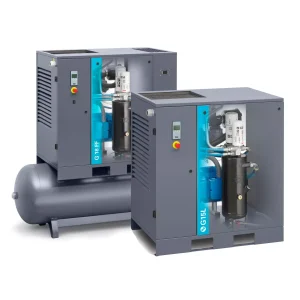
Single vs Two-Stage Compressors: Which Do You Need?
When Do You Need a Two-Stage Compressor?
Your required operating pressure is the most critical filter for this decision. A single-stage compressor will run hot and break down early if you try to push it too hard.
7–9 Bar (100–130 PSI): Single-Stage is Usually Sufficient
Most common pneumatic tools – drills, impact wrenches, spray guns, and the rest – tend to run happily at around 6.2 bar (90 PSI) at the inlet.
For day-to-day workshop jobs that stay below roughly 9 bar, a single-stage compressor is usually the straightforward, efficient option.
It’s also a good value. The Atlas Copco LE series is a great example of an industrial-grade single-stage unit that works very well in this range.
10 Bar+ (145 PSI): Two-Stage is Mandatory
If your application requires sustained pressure above 10 bar, a single-stage unit will struggle.
The heat produced in a single compression stroke at these higher pressures can push lubricating oil past its limits and lead to valve carbon buildup over time. If you need consistent performance between 10 and 14 bar, a two-stage compressor is the sound engineering choice for both reliability and service life.
15 Bar+ (217 PSI): Specialist High-Pressure Applications
Some industries have rules about safety that must be followed.
For instance, inflating the tyres on a commercial heavy goods vehicle (HGV) usually requires pressures higher than 150 PSI (10.3 bar). For these environments, a two-stage compressor is not just recommended; it is often the standard for safety.
Specialised units, such as the Atlas Copco LT series, can even reach pressures up to 30 bar for specific industrial manufacturing processes.
How Does Volumetric Flow (FAD) Influence Selection?
While pressure is about the “force” of the air, flow is about the “volume.” Free Air Delivery (FAD) or Cubic Feet per Minute (CFM) are used to measure this.
The air is denser because two-stage compressors cool it between stages.
Denser air means you get more actual air volume output for every kilowatt of energy you use. If your workshop has a high volume requirement—running multiple tools at once—investing in the efficiency of a two-stage unit will lower your running costs over time.
You can learn more about sizing your system correctly in our guide on Mastering CFM and PSI for Accurate Compressor Selection.
How Do Duty Cycles and Thermal Limits Work?
The duty cycle shows how long a compressor can stay in motion before it needs time to cool. It’s also where DIY models and professional machines often get mixed up, because the limits aren’t always clear when you’re comparing them side by side.
Entry-Level Single-Stage
The majority of single-stage belt-driven compressors available at hardware stores have a 50% duty cycle rating.
That kind of rating means you’re expected to stop for ten minutes after running the machine for ten minutes. Use it on a tool with steady, continuous demand – a sander, for example – and it will run hot and eventually shut itself down.
Industrial 100% Duty Cycle
But not all single-stage units are made the same way. The Atlas Copco LE (single-stage) and LT (two-stage) series utilise industrial Direct Drive technology with heavy-duty bearings and fan-forced cooling.
These units are built for a true 100% duty cycle. In practice, that means a properly sized industrial compressor – single-stage or two-stage – can run continuously without overheating, as long as the pressure requirement matches its design.
When Should You Consider Rotary Screw Technology?
There are times when neither single-stage nor two-stage piston compressors are the best choice. If your facility runs 24/7 or has a constant, flat-line demand for air, reciprocating technology may be inefficient.
In these scenarios, rotary screw technology is often superior. The Atlas Copco GA series (5–30) machines use rotary screw elements that inject oil.
The oil seals the rotors and cools them down, which lets the compressor run all the time with little noise and high efficiency. While smaller screws are often single-stage, the oil cooling allows them to handle high workloads that would destroy a standard piston unit.
Check out our article on Reciprocating vs. Rotary Screw Compressor Technology for a more in-depth look.
What Are Your Obligations Under PSSR 2000?
You’ll need to be clear on what the Pressure Systems Safety Regulations 2000 (PSSR 2000) require from you once a compressor upgrade is in the mix, as these rules set out the legal duties for anyone responsible for a pressurised system.
The 250 Bar-Litre Threshold
In the UK, rules only apply to systems where the Pressure (in Bar) times the Receiver Volume (in Litres) is more than 250.
A small single-stage unit rated at 8 bar with a 24-litre receiver comes out at 192 bar-litres, which usually keeps it below the point where a Written Scheme of Examination (WSE) is needed.
Scale up to an 11-bar, 200-litre two-stage machine, and you’re at 2200 bar-litres, well into the range where a WSE becomes mandatory.
Under Regulation 8, this WSE must be drawn up by a “Competent Person.” Operating a system above this threshold without a valid WSE is a breach of health and safety laws and will likely invalidate your insurance.
At Search Air, we can provide the statutory inspections and documentation you need to ensure you remain fully compliant.
How Does Your Electrical Supply Constrain Your Choice?
Your building’s electrical infrastructure is often the deciding factor in which compressor you can install.
Single-Phase Supply
Most standard UK 230 V sockets are capped at 13 A. The bigger 32 A circuits are usually hardwired, not something you can just plug into.
Put those two facts together, and you hit a hard limit on motor size – around 2.2 kW (3 HP) in most setups.
Consequently, most plug-and-play compressors are single-stage units. You should also be aware that motors have a high start-up current (inrush), often 4–6 times their running current, so you may need Type D circuit breakers to prevent nuisance tripping.
Three-Phase Supply
Most two-stage industrial compressors use motors that are 4 kW or more.
Typically, two-stage units run on a three-phase, 400 V feed.
It’s something to check early, because not every workshop has that wiring in place. In some situations, arranging a new supply can overshadow the price of the compressor itself.
What Is the Real Total Cost of Ownership?
People often fixate on the sticker price, yet it barely registers in the long run.
What really drives the bill is the electricity. By the time a compressor has done a few years’ work, energy can make up somewhere around 70–80% of what you’ve spent on it overall.
Two-stage compressors usually carry a higher upfront price, but they pay it back through better output per unit of energy. Running cooler helps the whole assembly – valves, piston rings, even the oil – last longer and stay in better condition.
This means that there will be fewer problems, longer service intervals, and lower energy bills. A two-stage unit usually pays for itself in 3 to 5 years if the workshop is busy.
For exact definitions of the technical terms used here, go to our page on Single-Stage vs. Two-Stage Compressor Definitions.
Conclusion: Which Compressor Is Right for You?
Before choosing between a single-stage or two-stage setup, take a moment to look at the basics.
Start with what you can realistically spend. Then think about how much work the compressor will see. Finally, check the pressure your tools actually need. Put together, those pieces point you toward the right option.
- Select Single-Stage (Atlas Copco LE) if: you’re handling general workshop tasks, you need to keep costs tight, and your requirements stay below the 10-bar mark.
- Select Two-Stage (Atlas Copco LT) if: You need pressures higher than 10 bar (like for HGV tires), you have a lot of heavy-duty demand, or you want to lower your energy bills in the long run.
- Select Rotary Screw (Atlas Copco GA) if: You need a quiet, super-efficient solution because you need air all the time.
Next Steps
If you are unsure about your pressure requirements or electrical supply, don’t guess. Contact the engineering team at Search Air today. We can perform a PSSR 2000 compliance audit and a system sizing assessment to ensure you get the right machine for your business.